Lumiglyph
A picture you can read, hear, and turn.
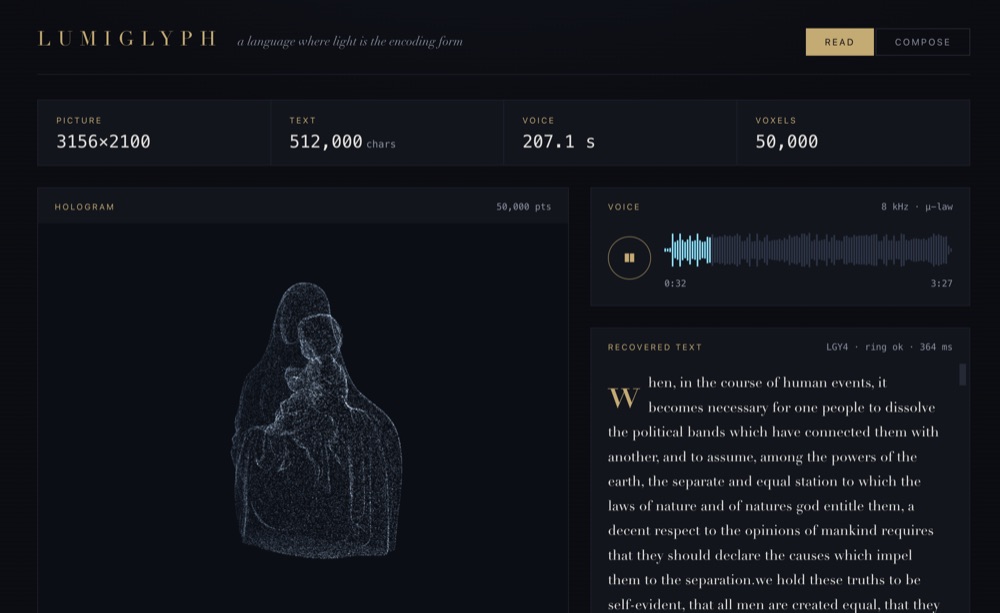
One lossless PNG that carries text, a spoken voice, a 3D point-cloud hologram, and a face — all encoded in the light of the image itself.
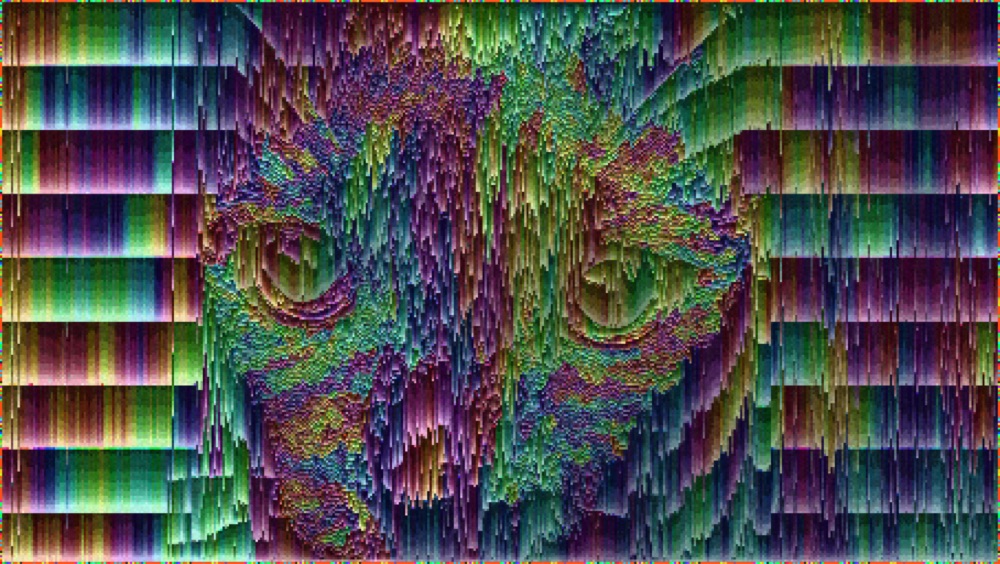
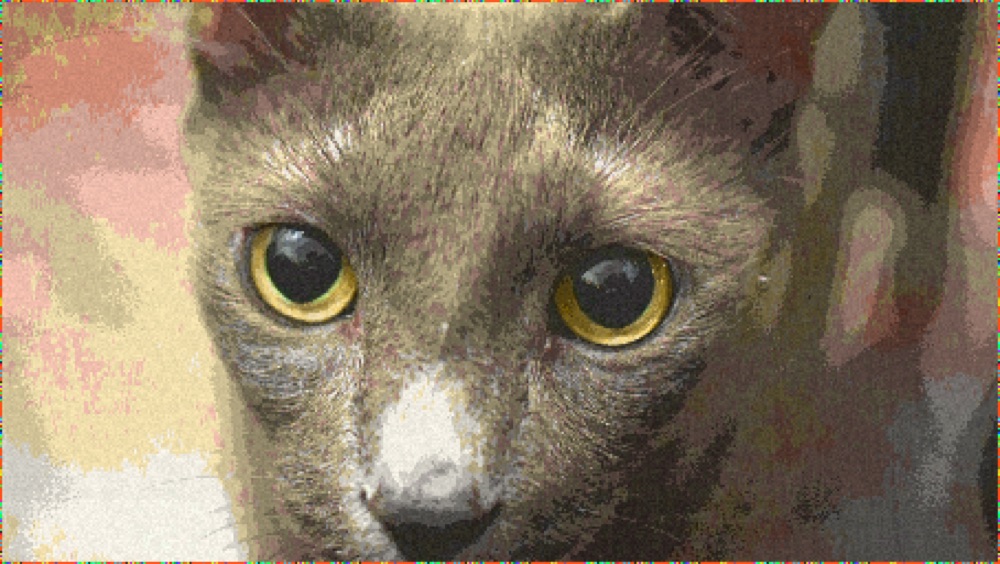
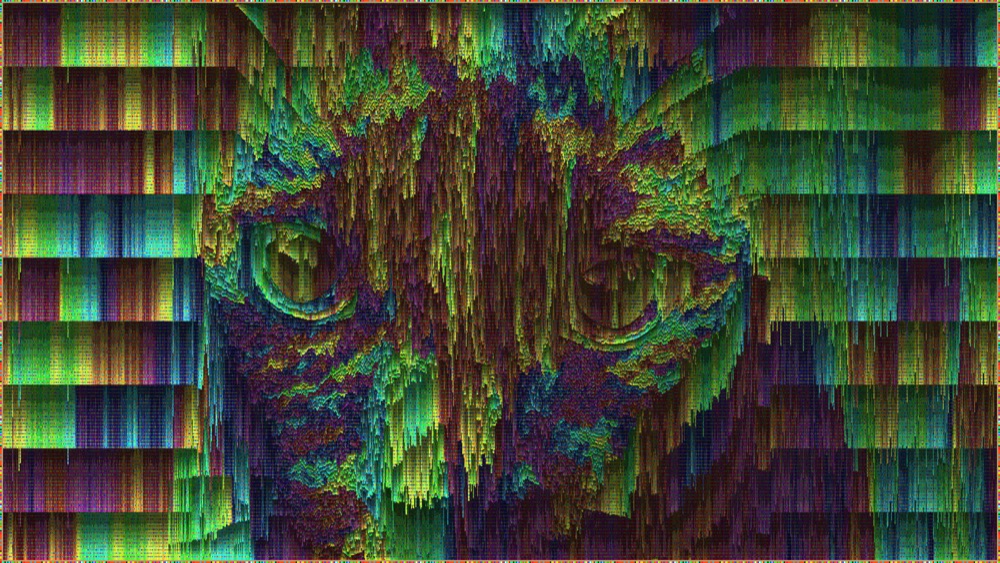
I was improvising a fake backstory over a pixel-sorted image — "a language where light is the encoding form" — and liked the lie enough to make it true. So I stopped talking and built it.
Four different payloads have to share the same pixels without one stepping on another, and the whole thing still has to decode — even after you photograph it off a screen and hand the codec a blurry, glare-streaked copy.
The trick is that max(R,G,B) recovers the value byte exactly, and the text lives on a rigid 10-pixel grid — so the reader samples known slots instead of hunting for bands. That frees the gutter rows to carry the picture's own colour: brightness draws the image, hue is the code. I wrote it twice, in JavaScript and Python, and made them read each other's files bit-for-bit so neither could quietly cheat.
It's live at lumiglyph.quiettools.dev with a Read mode and a Compose mode. The newest piece, Lumiscan, decodes a Lumiglyph you've photographed off another screen — the code survives leaving the pixel grid entirely. A recorded face is stored as motion over its own capture, so the likeness that speaks travels inside the picture.
Devlog
live from git- Lumiscan: full tonal depth via brightness-driven erasures, and a survey
- Lumiscan: finer grid and more contrast, at the measured frontier
- Lumiscan: mosaic mode — brightness draws the picture, hue is the code
- Lumiscan v0: a Lumiglyph you can photograph
- Trim the brief to one read
- RESUME.md — session brief
- Hologram: depth was inverted, and everything was framed too tight
- Starfall rhythm is a choice: banded or organic
This is a from-scratch codec with two independent implementations verified bit-for-bit, surviving a lossy trip through a phone camera — the kind of low-level, prove-it-works engineering most "AI-generated" projects never reach. If your hard problem is packing more into a format than it was ever meant to hold, this is the receipt.